
Secret Benefits, one of the leading sugar dating platforms in the United States, has launched an AI-powered profile verification system designed to combat fake accounts and fraud across its user base of millions. The rollout, announced in late March 2024, represents one of the most sophisticated automated verification efforts yet deployed in the sugar dating sector, which has faced mounting pressure from regulators and users over safety concerns.

The system leverages machine learning algorithms to analyze profile photos, biographical information, and user behavior patterns during account creation and ongoing platform use. According to Secret Benefits, the technology can identify and flag potentially fraudulent accounts with accuracy rates exceeding industry standards, though the company declined to share specific performance metrics.
The launch arrives as the sugar dating industry confronts a critical juncture. Market analysts project substantial growth for the sector through 2026, yet platforms simultaneously face intensifying scrutiny from consumer protection agencies and privacy advocates over user safety protocols.

How the verification system operates
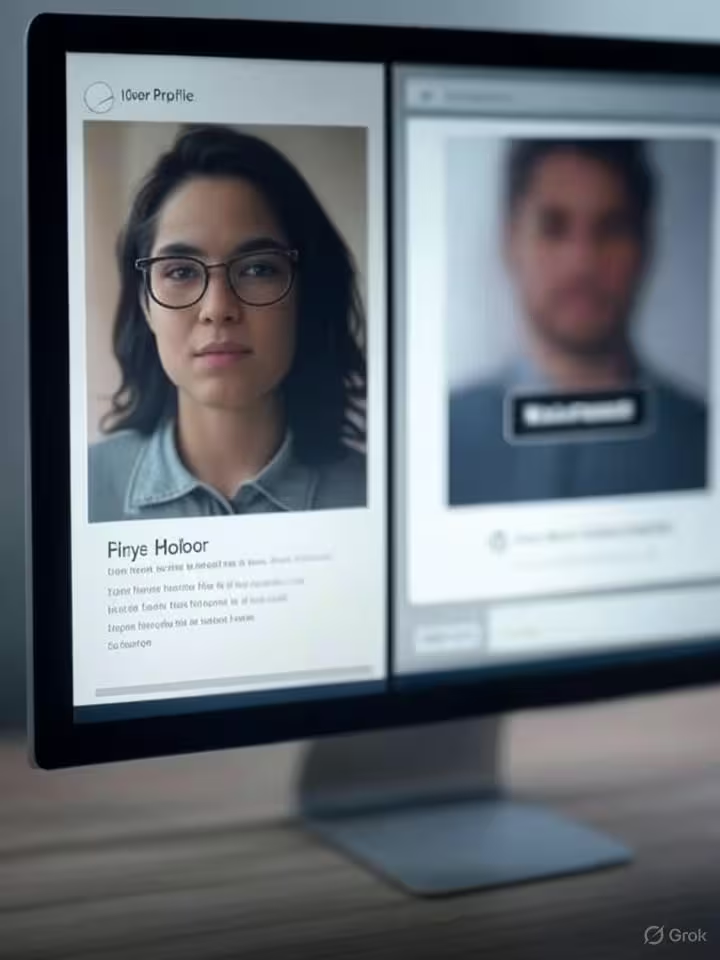
The AI-driven tool integrates directly into Secret Benefits‘ registration infrastructure and operates continuously across existing user accounts. The system employs three primary verification mechanisms, according to technical documentation reviewed by Sugar Daddy Site.
First, the platform’s facial recognition component analyzes uploaded photos against databases of known stock images and previously flagged fraudulent profiles. The technology also examines metadata embedded in image files to detect manipulation or sourcing from generic image repositories commonly used by scammers.
Second, the system cross-references biographical details provided during registration—including stated locations, occupations, and educational backgrounds—against publicly available records and pattern databases. This component aims to identify statistical anomalies that frequently characterize fabricated profiles.

Third, behavioral analysis algorithms monitor account activity in real-time, flagging patterns associated with fraudulent behavior such as rapid-fire messaging to multiple users, requests for off-platform financial transactions, or communication patterns matching known scam scripts.
A spokesperson for Secret Benefits emphasized the system’s privacy-preserving architecture: “The verification process utilizes anonymized data processing techniques designed to comply with state privacy regulations including the California Consumer Privacy Act. Personal information is not stored beyond the verification process unless users explicitly consent to enhanced verification options.”
The technical approach reflects broader industry movement toward automated safety systems. According to the Online Dating Association, 45% of major dating platforms had implemented some form of identity verification by 2023, up from just 12% in 2020. However, Secret Benefits‘ real-time AI monitoring represents a more comprehensive approach than the manual document upload or video verification systems common among competitors.
Industry context and competitive pressures
The verification system launch occurs against a backdrop of rapid expansion and mounting challenges across the sugar dating sector. The online dating market generated $3.18 billion in U.S. revenue during 2022, with sugar dating platforms representing an estimated 8-12% of that total, according to data from Statista.
That growth has attracted regulatory attention. The Federal Trade Commission documented romance scam losses exceeding $1.3 billion in 2023, with sugar dating platforms frequently identified as origination points for fraudulent schemes. Congressional committees held hearings on online dating safety in February 2024, with several lawmakers calling for mandatory verification standards across all relationship platforms.

“AI verification tools represent a proactive governance approach that could significantly reduce platform liability while improving user experiences. The question is whether automated systems can achieve the accuracy and fairness necessary for widespread deployment.”
— Dr. Elena Ramirez, Center for Digital Ethics, Stanford University
Competitive dynamics have also intensified. Seeking, the market leader in sugar dating, reported 20% user growth in Q3 2024 while offering manual verification through video calls and government ID uploads. Other platforms including SugarDaddyMeet and Luxury Date have introduced photo verification requirements, though none had deployed comprehensive AI systems prior to Secret Benefits‘ announcement.
Industry analysts suggest the technological arms race reflects user demand for safer platforms. A 2023 survey by DatingNews.com found that 62% of online daters consider robust safety features their top priority when selecting platforms, ranking above matching algorithms or user interface design.
“Verification has transitioned from a nice-to-have feature to a fundamental requirement,” said Jennifer Park, digital marketplace analyst at PwC. “Platforms that fail to demonstrate credible safety measures risk losing market share to competitors who invest in these technologies.”
Potential benefits and business implications
Internal testing data provided by Secret Benefits suggests the AI system could reduce fake profile prevalence by up to 70% compared to manual moderation alone. The company projects this could translate into measurable improvements across multiple business metrics.
Platform engagement data from similar verification deployments on mainstream dating apps indicates verified user bases demonstrate 25-30% higher retention rates and 40% longer average session times. For sugar dating platforms where financial arrangements create elevated trust requirements, these improvements could prove even more significant.
The financial case for AI verification extends beyond user acquisition. PwC estimates that automated verification systems can reduce content moderation costs by 35-50% while simultaneously decreasing legal liability exposure. For platforms processing millions of profiles annually, these savings could reach seven figures.
“The ROI calculation becomes compelling when you factor in reduced customer service costs, lower churn rates, and decreased regulatory risk,” Park noted. “AI verification represents both a defensive and offensive business strategy.”
Legal experts suggest the system may position Secret Benefits favorably as regulatory frameworks evolve. Mark Thompson, who specializes in digital platform law at the American Bar Association, observed that proactive safety measures often influence regulatory outcomes:
“When platforms demonstrate good-faith efforts to address safety concerns through technological innovation, regulators tend to favor industry self-regulation over prescriptive mandates. This could establish Secret Benefits as a compliance leader if federal verification requirements emerge.”
The verification system may also influence demographic trends within sugar dating. Recent analysis shows wealth concentration reshaping user demographics, with high-net-worth individuals increasingly concerned about privacy and security. Enhanced verification could attract this valuable user segment while deterring opportunistic fraud.
Privacy concerns and algorithmic bias questions
Despite potential benefits, the AI verification rollout has generated substantial criticism from privacy advocates and civil liberties organizations. The Electronic Frontier Foundation has consistently challenged facial recognition deployment across consumer applications, citing data security risks and surveillance concerns.
“Users entrust platforms with highly sensitive personal information and images,” said Sarah Myers, senior staff technologist at EFF. “The question isn’t whether verification is valuable—it clearly is—but whether companies can implement these systems without creating new privacy vulnerabilities or enabling misuse of biometric data.”

Data breach concerns carry particular weight in sugar dating contexts, where user privacy often involves professional reputations and personal relationships outside the platform. Security researchers note that facial recognition databases represent high-value targets for malicious actors, potentially exposing users to blackmail or harassment if compromised.
Secret Benefits maintains that its system processes biometric data ephemerally, generating verification scores without permanently storing facial maps. However, privacy experts note that even temporary processing creates potential exposure windows, and few platforms have demonstrated robust security against determined attackers.
Algorithmic bias presents equally significant concerns. Research from the AI Now Institute at New York University has documented that facial recognition systems demonstrate error rates up to 35% higher for women and people of color compared to white men. In dating contexts, these disparities could result in legitimate users being flagged as fraudulent or denied platform access.
Dr. Raj Patel, who researches algorithmic fairness at MIT, emphasized these risks: “Sugar dating platforms serve racially and ethnically diverse user bases. If verification systems exhibit demographic biases, they could inadvertently discriminate against the very communities they aim to protect while providing false security against sophisticated fraud.”
The Online Dating Safety Coalition, an advocacy organization, has called for independent auditing of AI verification systems before widespread deployment. “Platforms should publicly demonstrate that their algorithms perform equitably across demographic groups,” the organization stated in response to the Secret Benefits announcement. “Absent that transparency, users cannot make informed decisions about these systems.”
Effectiveness questions and evolving fraud techniques
Cybersecurity experts caution that AI verification, while promising, faces limitations against sophisticated fraud operations. The technology that enables verification—machine learning and image analysis—can also be weaponized by determined scammers.
Deepfake technology has advanced rapidly, with commercially available applications now capable of generating photorealistic synthetic images that fool many AI detection systems. Research published in IEEE Transactions on Information Forensics and Security found that state-of-the-art deepfakes successfully bypassed facial recognition systems in 45% of test cases.
“We’re witnessing an arms race between verification and fraud technologies,” Dr. Patel explained. “As platforms deploy more sophisticated detection, fraud operations respond with increasingly advanced evasion techniques. AI verification should be one component of comprehensive security strategies, not a standalone solution.”
VPN usage and location spoofing present additional challenges for behavioral verification components. Fraud operations increasingly operate through distributed networks that obscure geographic origins and mimic legitimate user patterns. Security researchers note that professional scam operations often employ individuals who naturally exhibit genuine-seeming behaviors, rendering pattern analysis less effective.
Human oversight remains critical, multiple experts emphasized. “Automated systems excel at scale and consistency but struggle with contextual judgment,” said Dr. Ramirez. “Effective verification likely requires hybrid approaches that combine AI screening with targeted human review for edge cases and appeals.”
Secret Benefits acknowledged these limitations while maintaining confidence in its approach. The company spokesperson indicated that the system undergoes continuous refinement: “We monitor false positive and false negative rates closely and adjust algorithmic thresholds based on performance data. User feedback mechanisms allow individuals to contest incorrect flags, with human reviewers examining disputed cases.”
Implications for industry standards and regulatory trajectory
The Secret Benefits verification launch may catalyze broader technological adoption across sugar dating platforms and adjacent sectors. Industry observers note that competitive pressure often drives rapid diffusion of safety innovations, particularly when market leaders demonstrate tangible benefits.
“Once one major platform implements comprehensive verification, others face pressure to match or exceed those standards,” said Park. “Users increasingly expect verification as baseline functionality, not a premium feature. Platforms without credible safety measures risk being perceived as second-tier options.”
The development arrives as sugar dating attracts growing mainstream attention, with media coverage examining the sector’s expansion among professional demographics. This visibility brings both opportunity and scrutiny, with platforms under pressure to demonstrate legitimacy through responsible governance.
Regulatory implications remain uncertain but significant. While no federal verification mandates currently exist for dating platforms, legislative proposals introduced in 2024 would require identity verification for social media and matchmaking services. State-level initiatives in California and New York have explored similar requirements.
Thompson noted that proactive industry adoption of verification standards could influence regulatory approaches: “Legislators generally prefer self-regulatory frameworks when industries demonstrate good-faith efforts to address policy concerns. Widespread voluntary adoption of AI verification might forestall more prescriptive government mandates that could prove operationally challenging for smaller platforms.”
However, regulatory outcomes depend partly on whether AI systems prove effective and equitable in practice. If verification technologies demonstrate significant bias or fail to meaningfully reduce fraud, lawmakers may pursue alternative approaches including mandatory human verification, third-party auditing requirements, or platform liability frameworks.
The international context also matters. European regulators have implemented stricter data protection requirements under GDPR, while countries including Australia and Canada are developing online safety frameworks that could encompass dating platforms. U.S. platforms with international user bases must navigate varying regulatory landscapes, potentially requiring different verification approaches across markets.
What comes next
As Secret Benefits begins gathering performance data from its AI verification system, industry stakeholders will closely monitor outcomes across multiple dimensions: fraud reduction effectiveness, user acceptance rates, demographic equity, and competitive impact.
The company indicated it will publish periodic transparency reports detailing system performance, though specific metrics and publication schedules remain undetermined. Privacy advocates have called for independent auditing of these reports to verify accuracy and comprehensiveness.
Other platforms are likely evaluating similar technological investments. Seeking has not commented on potential AI verification deployment, while smaller competitors may face cost barriers to developing comparable systems. This could drive consolidation within the sugar dating sector, with smaller platforms either partnering with technology providers or being acquired by larger competitors with verification capabilities.
The verification technology itself will continue evolving. Researchers are developing next-generation approaches including behavioral biometrics, blockchain-based identity systems, and federated learning models that enhance privacy while maintaining security. Whether Secret Benefits and competitors adopt these emerging technologies will shape the industry’s safety landscape.
User behavior represents the ultimate success metric. If AI verification meaningfully improves trust and safety while respecting privacy, user engagement should increase and fraud complaints should decline. Conversely, if the system generates excessive false positives or fails to stop sophisticated fraud, platforms may need to reconsider their approaches.
For an industry that has evolved from stigmatized fringe to multi-billion dollar market segment, the verification question represents more than technological choice—it reflects fundamental decisions about platform governance, user protection, and social legitimacy. How Secret Benefits and its competitors navigate these challenges will likely define the sugar dating sector’s trajectory through the remainder of the decade.